If it were possible for a village to slip through the fingers, I think Bunbury would be one of them. Once a portal to Delamere forest, it is now suspended between two main roads from Tarporley, meagrely sign-posted as if intent on not drawing attention to itself. Bunbury, after all, is famous for its aloof attitude. The overlarge church on the top of the hill, St Boniface’s, the birthplace of nothing more valiant than a Treaty of Pacification just as the Civil War started: soldiers to disband, prisoners to be released and all captured goods to be returned. Please. If you don’t mind. Just leave us alone. It lasted just over a fortnight.

Standing here, I go back further to a time of ice-dumped boulder clay and gravel and silt, and hunters are finding a way through sandstone hills as the earth becomes warmer. They dropped stone axes, and then bronze arrowheads, and they cremated their dead before burying them under a small barrow, like the one close to the aptly-named Traveller’s Rest in Alpraham. That old inn is closed now, and Alpraham transformed over the last couple of years with high-end executive homes with tall windows, together with a collection of smaller houses at the eastern outskirts of the village. All of them still clinging to the familiarity of the Nantwich Road as if hesitant to risk adventure.

Was this a Roman road; a side-shoot of the road from Deva to Whitchurch to the valuable salt deposits in Nantwich and Middlewich, and the potteries of Wilderspool? Or was it something earlier, skirting alongside the hill settlement of Bunbury, later becoming perhaps an Anglo-Saxon buhr – one of a string of forts protectively encircling Deva. Underneath St Boniface is charcoal maybe indictating something earlier, and perhaps confirming this, the Domesday book records a priest as well as two villeins – (indentured) tenants of the lord of the manor – living on half the land, with the other half kept for the lord himself.
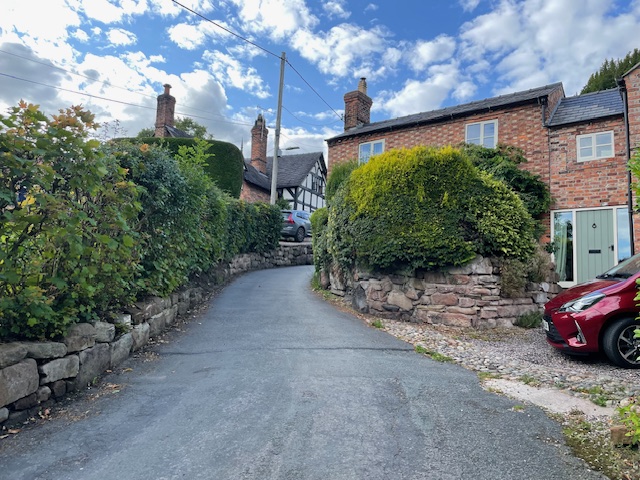
Bunbury at the time was a gateway to forests. The trees of ‘Mara and Mondrem’ stretched from the Mersey to Nantwich and were well-stocked with game for the Earl of Chester and his barons to hunt. The Grosvenors hunted here, and the Mortons, the Weavers and the Kingsleys.
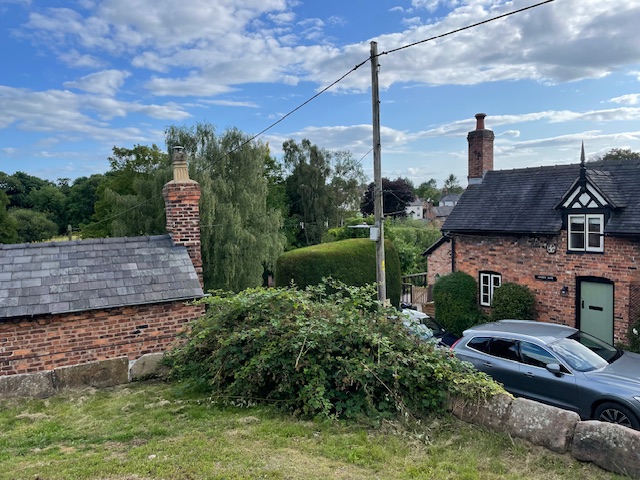
Years passed, and Bunbury hunkered down, a tightly wound ball of wool, names of the villagers like tendrils briefly appearing in the records.
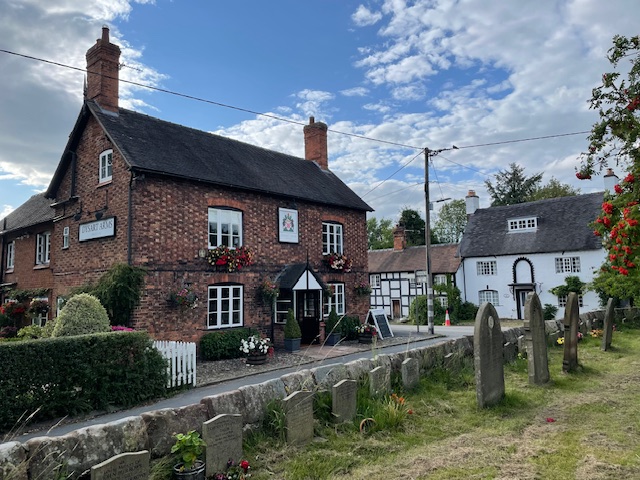
1128 and the Kingsleys are granted jurisdiction of the forest, then, later, their heirs the Dones become the Master Foresters with the right to mete out punishments for the slightest infringement – and they do: hangings and beheadings in small tight script and the misery, fear.
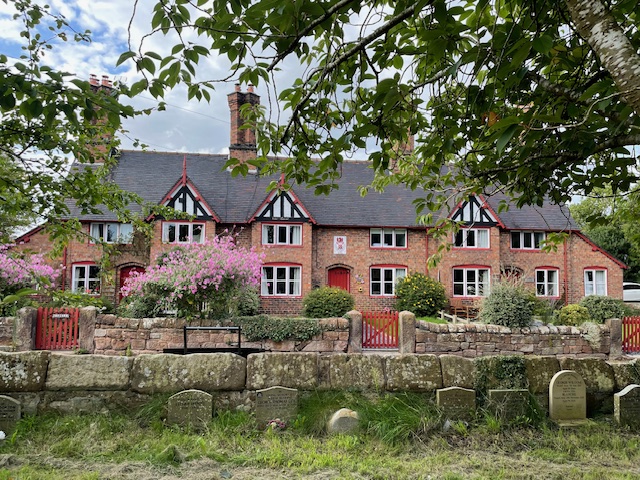
1175 and the Lord of Banbury appears, one Humphrey Patric, and then in 1190 two granddaughters Ameria and and Joan end up as heiresses and matriarchs of the Patrics and the Bunburys.
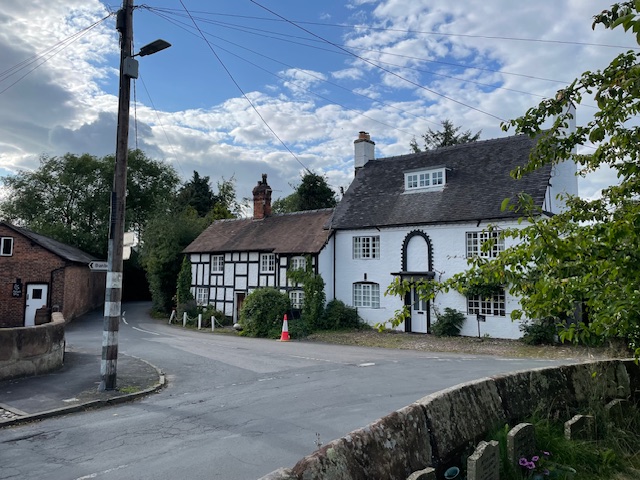
These names fleck the ball again and again – from the Norman crusade to the seventeenth century: the Beestons, the St Pierres, the Calveleys and the Knowles.
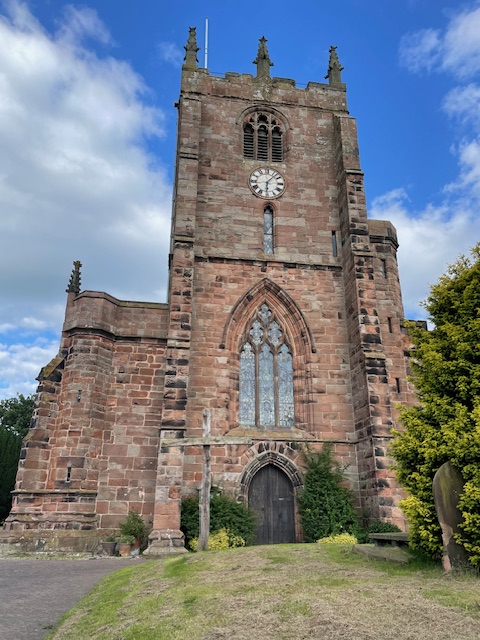
And then, in 1386, Sir Hugh Calveley appears. He’s in his sixties and this stage, and the last twenty years have been interesting ones. He’s led the famous Cheshire long-bow archers, burnt ships, destroyed towns, founded hospitals and been an admiral and a governor no less than three times. But now it’s time for Sir Hugh to take stock, and in the fourteenth century, this can mean only one thing: preparation for the afterlife. The first earl of Chester had established an abbey, but Sir Hugh’s ambitions have to be more modest He will establish a college at St Boniface Church with a chantry and also appropriate its rectory, and, just for completeness, he will buy the manorial rights to the entire village and unite it under his sole ownership. From now on, Bunbury will be Sir Hugh Calveley.
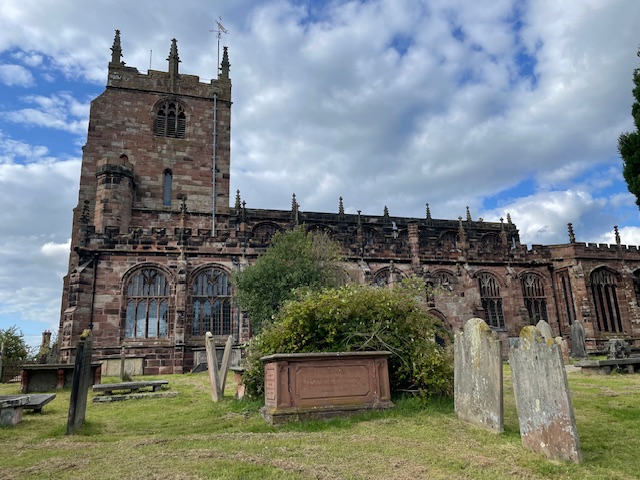
Much of St Hugh’s collegiate church survives to this day – including his elaborate tomb. He died a bachelor and the tomb was probably erected by his fellow crusader Sir Robert Knolles. They were clearly good friends because around the the Knolles family arms are placed alternatively with Sir Hughes around the tomb.
The village is growing now, a rolling ball collecting lint. The village acquires houses, a market and the annual St Boniface Wake. The villagers drunkenly bait bears and bulls, pitch cockerels and men against each other and place bets on their fates.
But then the ball slows. The Reformation has come and Sir Hugh’s chantry is dissolved. His soul can fend for itself.
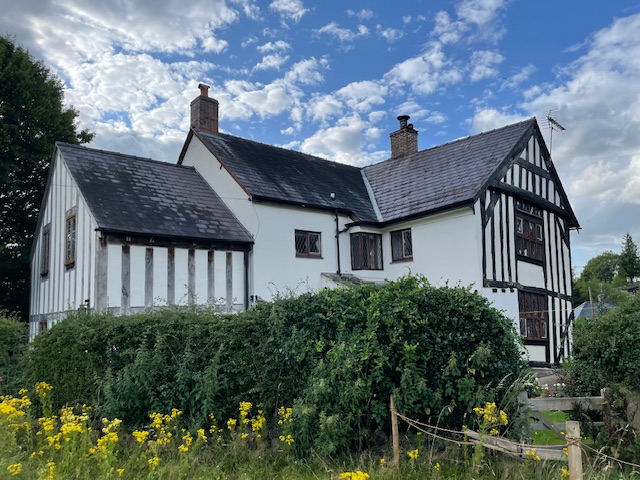
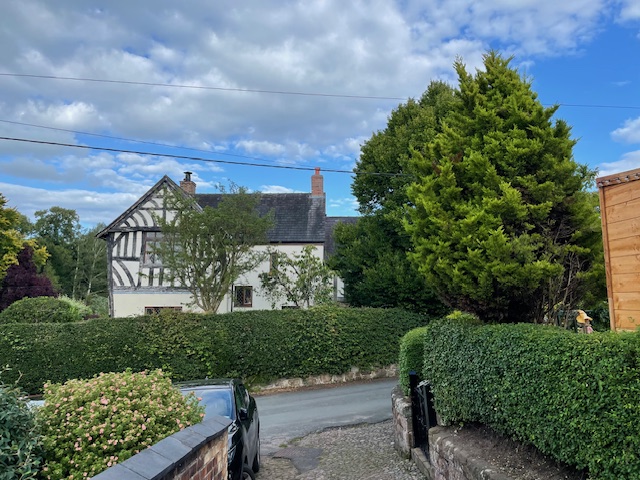
1594 and along comes Sir John Alderney. A haberdasher rather than a soldier, but no less a hero. Beside the chantry house he builds a grammar school, and installs a headmaster, John Glover, in the chantryhouse next door. It’s still here: on the other side of the Gowy valley, but close to the river, and it’s why I’m here. It is reportedly the School of John Bradshawe, and he certainly left £500 in his will for the improvement of the headmaster’s salary.
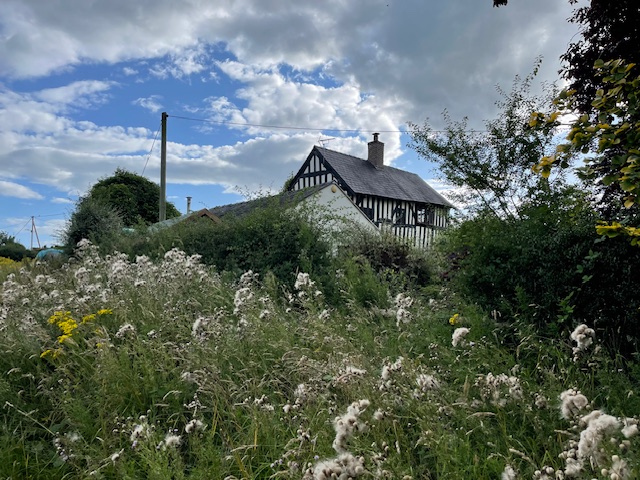
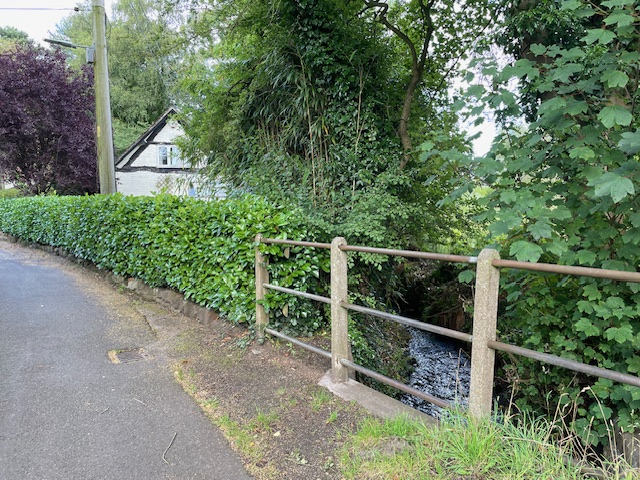
There’s a footpath in the field. It leads around the house and then comes out on the road again. Did John Bradshawe walk here? Did Mary Marbury? Did they lodge in this old chantryhouse and then go over the bridge to hear the Puritan William Hinde preach?
I have been trying to find out how likely it is that she came here. At first I thought it possible because there is a Marbury close to Bunbury (Marbury near Whitchurch), just a three mile walk away. But then I discovered, looking at the Marbury family tree in ‘The History of the County Palatine and City of Chester’ p. 470 Vol 1 this was clearly the wrong Marbury since burials took place at Great Budworth. Mary’s Marbury then was the one close to Northwich. This made the idea of Mary attending this school seem less likely to me.
But then I discovered that Mary’s mother, Eleanor Marbury (née Eleanor Warburton of Arley), died giving birth to her, and Mary was in fact brought up by her aunt, Jane Brereton (Jane Warburton of Arley) and her husband, William Brereton of Ashley. So I looked up Ashley, and that is even further from Bunbury – a ten hour walk away in fact. I discovered from Richard Lee Bradshawe’s biography of John Bradshawe, ‘God’s Battleaxe’ that one of William Brereton’s children, Peter, was a contemporary of John Bradshawe’s at Bunbury school. So, if he went there, maybe Mary went along too.
There was a problem with that, however. Although girls were admitted to the school, they were not encouraged, and their presence only tolerated until they could either read or were aged eight. Since Peter Brereton was six years younger than Mary, the timings were out. However, consulting Omerod again, I discovered that Peter had siblings, three of them in fact, and Mary was exactly the same age as one of them. So I think it quite feasible that she would have gone along too. Like her cousins she’d have had to board in this Chantry House with the headmaster and his family, but she would have learnt alongside them and been exposed to the same Puritan education and ideas from the renowned William Hinde. An exciting thought.
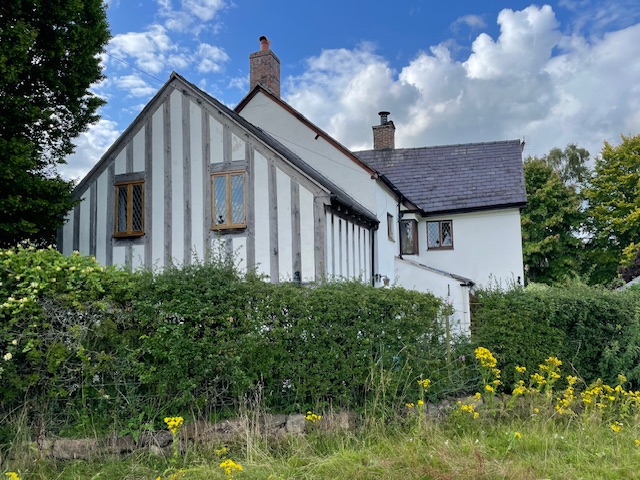
Years passed. Mary left the school and so, eventually did all the cousins alongside John Bradshawe. He remembered the place fondly though, because to show his gratitude he left £500 to improve the salary of the head teacher, although this was stopped by Charles II, when the Stuarts were returned to the throne a year later. Perhaps as a result of this, the school at Bunbury went into decline, while the world around it changed. Eventually, in 1874, the school building was replaced by a Grammar School along School Lane designed by John Douglas, and the pupils moved there. In 1960 it changed again – this time to become the village’s primary school – and continues to thrive today. But it is interesting to think that the Aldersay School is still educating young children, just as it educated Mary Maybury, the Brereton boys and John Bradshawe four hundred years ago.

References:
Bunbury: The History of a Cheshire Village. Edited by Frank A Latham. 1992.
God’s Battleaxe: The Life of Lord President John Bradshawe (1602 1659) by Richard Lee Bradshaw. 2010
The History of the County Palatine and City of Chester by George Omerod 1819
 Clare Dudman